

Quick Links
ChildRaise launches "Purple Day Purpose Day" Campaign

Purple Day is Purpose Day indeed !!
This year ChildRaise Launches " Purple Day Purpose Day" Campaign to celebrate March 26th -Purple Day founded by Cassidy Megan. Every one person in 100 has epilepsy.Living with Epilepsy is a challenge. It requires a lot of determination. A sense of resolve to surmount the challenges that epilepsy presents. In this campaign we are sharing stories, initiatives,trials, triumphs of people with epilepsy & what drives them, prompts them, motivates them.
How did the Purple Day start? Read how Cassidy Megan, a tiny little girl of nine started Purple Day to raise Epilepsy Awareness in a big way.

The idea of Purple Day was created by nine year old Cassidy Megan in 2008, motivated by her own struggles with epilepsy. Cassidy’s goal is to dispel myths and inform those with seizures that they are not alone. The epilepsy association of Nova Scotia came on board in 2008 to help develop Cassidy’s idea which is now known as Purple Day Campaign for Epilepsy.
After the Federal Parliament passed the Purple Day Act in Canada, March 26th is now officially recognized by law as Purple Day for epilepsy awareness in Canada and now this movement is gaining roots in other parts of the world as well.
We i.e. ChildRaise Trust was the first organisation to celebrate Purple Day in India in the year 2010 & become the Official Indian Partner of Purple Day Organisation. In the past two years, besides having our independent events for epilepsy awareness, we are also joining hands with Dr.Janak Nathan who is the Chief Coordinator of Purple Day India to strengthen the mission to educate the public and create awareness about epilepsy instead of fearing it.
To know more about Purple Day,
pl. log on to www.purpleday.org, www.purpledayindia.org, www.akfus.org
Priya Jain writes about her experience of working with Dr. Mamta Bhushan Singh & her unique initiative on Life Line Express to reach length & breadth of India & it's vast population having epilepsy.
Dr Mamta Bhushan Singh explaining epilepsy to patients and their families.

Patients being seen by Dr Singh inside a coach on the Lifeline Express.

Epilepsy Support Workers answering questions for patients seen by the doctor.
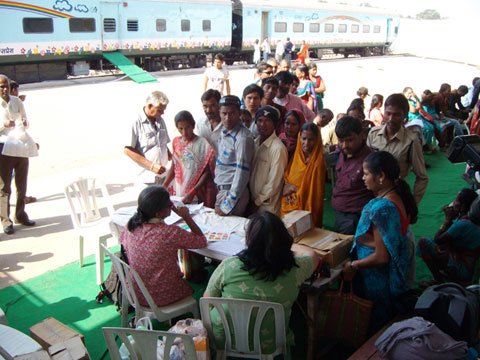
A weekend at the epilepsy clinic at the Lifeline Express
It was hard not to stare. Here was a man with horrific burn injuries that covered his head and torso. He sat waiting to see the doctor. Some time later I mustered up the courage to ask him what had happened and learnt that these burns were the result of falling into a vat of boiling oil during a seizure.
I was in Chattisgarh to join the epilepsy clinic held over a weekend each month by neurologist Dr Mamta Bhushan Singh, AIIMS, New Delhi on the Lifeline Express (LLE). The LLE, a hospital on a train is a project of Impact India. Each month it travels to a different location for three weeks reaching those who have little or no access to medical care and almost never to a neurologist. A team of us – neurologists Dr Victor Patterson (UK) and Dr Jerome Chin (USA), as observers and four of us from Delhi and Mumbai (social worker, counselors and an occupational therapist) had volunteered to assist the clinic. We wanted to see this project for ourselves and carry out a needs assessment exercise.
Patients had traveled from all over Chattisgarh to see Dr Singh and there was even one family from Odisha. Burns, broken limbs, injuries to the face and head – all indicated the consequences of uncontrolled and usually untreated seizure. Dr Singh had warned us that we would see horrific injuries, and yet the sight was shocking. We knew that many such injuries were preventable if only people had access to the right medical care.
In India 1% of the population or 12 million people are estimated to have epilepsy. According to the Indian Epilepsy Association, there are 1247 neurologists. Almost all neurologists are based in cities, while according to the 2011 census 68.84% of Indians live in rural India.
How would such a large rural population ever get the care they needed? But we could see that Dr Singh’s clinics were a small step in that direction. Over a weekend an average of 120 to 150 patients are seen by her. Through the day she also holds sessions talking to groups about what epilepsy is and is not. Those of us assisting the clinic were simply overwhelmed by the people crowding around us who had many questions about their treatment, about what to do during a seizure, whether their seizures might go away, and at times just to talk. It soon became evident that Epilepsy Support Workers are needed.
But what struck us most was the fact that at least 50% of those in India could lead a normal life if they had access to the right treatment. Without such access these untreated people with epilepsy suffered the consequences of uncontrolled seizures and yet epilepsy is not recognized as a disability in India.
Two months later, the husband of a patient seen in Chattisgarh called and said “I am so happy.” They had lost hope of his wife leading a normal life and with the frequent accidents particularly while cooking, his wife was almost suicidal. The treatment prescribed by Dr Singh was working. There were no more seizures. He had called to express his gratitude and to arrange a follow up visit to AIIMS.
In that moment it was clear that every effort to reach those with untreated epilepsy, such as the epilepsy clinic on the Lifeline Express, was worth it.
If you wish to volunteer, as a neurologist or as an Epilepsy Support Worker, and to see the schedule of the epilepsy clinic on the LLE, please contact us through the Facebook page of India Control Epilepsy.
The dates for the epilepsy clinic at the Lifeline Express are as follows:
19-20 April, 2013 - Gopalpur, Odisha.
25-26 May, 2013 - Jhansi, Madhya Pradesh.
Priya Jain has a degree in social work and has worked as a researcher on non-medical aspects of epilepsy. With a history of epilepsy she likes to think of herself as an epilepsy activist. She has also worked as a researcher on a legal study in Kashmir, and has published articles as a features writer and photographer.
Pramila Mankikar in conversation with Dr. Uday Andar, eminent neurosurgeon from Mumbai on new developments to treat difficult epilepsy.

Dr. Uday Andar ...Greetings from Childraise Trust! We are very glad that you have consented to speak to us on the occasion of Purple Day to promote Epilepsy Awareness. We take this opportunity to speak to you because you are in the neurosurgery field for many years & have witnessed several changes in terms of treatment options and changing attitudes.
We would like to know more about epilepsy and your experiences....
- Kindly let us know For how many years have you been in the field of neurology and what is your expertise?
I started my practice in neurosurgery 1980, so that makes it 33 years. And my area of expertise is Micro Neuro- surgery. - Is micro neurosurgery the same procedure used for epilepsy surgery also?
Yes, that's right. Micro neurosurgery is used for epilepsy surgery also. - Which is the area of the brain that is most affected when a person has an epileptic attack?
The attacks most commonly are in the temporal and frontal lobe. - How do you do the diagnosis and decide to go in for surgery?
Diagnosis is determined after administering several neuro-psychological tests. Decision is taken based on the results. It is a team decision guided by the neurologist and neuro-psychiatrist. - How do you deal with anxious parents and convince them that surgery is a good option?
- How important is post-operative care? What is the most important thing the patient has to take care of?
Medication and diet both are important. There are various diets that are given like GFCF diet, which are given to them by a dietitian.They need to be particular about their medication. If there is any loss of neurological functions, it has to be reported so rehabilitation services can be provided & they can be restored. . - What are the alternative therapies/medicines for epilepsy?
As a practicing neurosurgeon, I do not recommend any alternative medicine other than Allopathy. But in our practice , we do come across many patients, their caregivers who claim that homeopathy and ayurvedic medications have helped. But yes, breathing exercises and yoga brings down the frequency of seizures/ fits.
- What are the newer treatment options for epilepsy?
Vagal nerve stimulation. It is surgical but we do not operate on the brain instead we put a vagal stimulator in the neck.
Further research is on where something like a pacemaker will be implanted in the brain which detects the seizure and aborts them.Hope it comes soon. - Which are the hospitals you work?
I work at Bhatia, Wadia children hospital and Bombay hospital in Mumbai. . - Finally, on the occasion of Purple Day prescribe a message pill for all of us.
Message to society... look at achievers who made success of their life in spite of epilepsy. Include people with epilepsy in all walks of life, encourage them, support them. And to the person with epilepsy- Prayers/meditation & medication !!
Most of the parents come with the question of how to get rid of epilepsy. Today’s surgical methods can give a 70-80%result which is very optimistic in case of children, where if epilepsy is controlled early in life the brain develops normally. Especially if the temporal lobe is affected & the affected part is surgically removed, the rest of the brain grows normally.
The more convulsions/attacks per day the worse it becomes.Therefore, the parents have to be convinced that if their child is a suitable candidate for epilepsy surgery, then they should consider this option as it is safe & can provide their child good quality of life.
Thank You Dr. Uday Andar from ChildRaise & our readers.
(Pramila Mankikar is a counselling Psychologist & a school counsellor)
Life is so beautiful, Just don't lose hope, overcome fear! - Shenaz Haveliwala
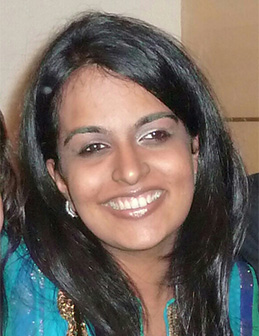
In 2005, at the age of 19, one week before my examinations, I lay down on my mother's lap complaining of a headache. The next thing I remember waswaking up in the hospital ICU. And, that was the first time I heard the word 'viral encephalitis'.
After mechanical engineering, I had decided to major in laser technology, a reality I had built in my head.I couldn't go back to university since I used to get seizures every day. Side effects of drugs were terrifying. My social life was hampered.
Mom and dad left nostone unturned. Everything they could do, was done. It was during this one year that i became part of the 'college editorial board' in the Times of India.I was still getting seizures almost every day. A miracle was my only hope.
Eventually I had to undergo a surgery atSreeChitra institute in Trivandrum. It was then that i came across patients from all walks of life; people from different cultures, age groups, cities, financial backgrounds. All of them bound by one common thread-epilepsy. It felt so relieving to know that I was not alone. There were millions battling with me. Unfortunately, for me, surgery was not a complete success. I have been on several AED's since the past nine years. I was desperate to support my medical expenses, at the same time, was fully aware that it will be difficult for me to find a job in another company. That is when, I decided to start a business of my own. I renovated my father's old warehouse in Fort to a conference hall. Since it is a commercial area, close to high court, there is a need for out of court settlements, arbitration matters etc. Giving it out on rent, I now support the finance of my own medicines. The hall is called SoboConnect and is now used for professional and other general meetings as well. It has made me feature inIndia's national business magazine 'Entrepreneur India'. Epilepsy could never stop me.
Promoting SoboConnect I learned the art of website designing. At the same time did not give up on my academics. Studying through correspondence, I graduated in the stream of commerce last year.
Currently, I'm working at the Indian Epilepsy Association (Mumbai Chapter) as a special educator for young adults with epilepsy. Along with regular studies, I strive to teach my students the importance of courage and persistence.In life, it does not matter how slowly you go, as long as you don't stop.
Just after I let happiness rule my life, in 2011, Dr. B.S.Singhal honored me with the'Most Courageously Living withEpilepsy' award. The same year, my story was featured in a book 'Conquering Epilepsy' edited by Carol D'souza.
I continue to get seizures and struggle to overcome the side effects of my current medication but i 'm happy I've learned to visualize the world my way. If you walk with hope in your heart, you never walk alone.
Few weeks ago, I received an award by the International Bureau of Epilepsy. I was invited to Singapore to receive a prestigious award at the Asian and Oceanic Epilepsy Conference as the 'Outstanding Person with Epilepsy'-2014. I encountered patients, delegates, doctors from various nations, cultures. It was overwhelming to see my work getting a global recognition.
My profession makes me so happy.It's now that I have become so much more grateful to Allah and can see the beauty in all his plans. Life will move forward, just keep in mind that there is light at the end of every tunnel.
For Epilepsy day this year, I will be inTrivandrum, to the same epilepsy ward I was admitted in for my surgery in 2007. Only difference is that this time, instead of being a patient I'll be going asthe guest of honor. Life is bringing me back to where I started from. It is such a proud feeling. Where there is a will, there is a way!
- Shenaz Haveliwala
Purple Day Events
- ChildRaise has organised a Newspaper Weaving Art by Neeta Nadkarni for adolescents with Spl. needs at Aawhan Palak Sangh , Kotwadi, Shivaji Park, Dadar, Mumbai Time 2-4pm.
All the articles made will be Purple & there will be exhibition & sale of these purple products. - Devaraya Shanbhag & Ganesh Kamath - two culinary experts will share their skills with cookery enthusiasts to raise funds for medicines for needy epilepsy patients.(Watch the space for details)
- ChildRaise Founder & Manging Trustee Kavita Shanbhag will deliver an awareness talk on Epilepsy on All India Radio on March 26th.
- Roopa Nadkarni - supporter of ChildRaise will organise an event in Bangalore.
- Awareness on www.facebook.com/childraise page & Twitter handle